Waiting for a government welfare program that actually delivers without political red tape or endless standing in lines can feel like an impossible ask in Pakistan. However, the Chief Minister Punjab Rahmat Card has completely shifted how social protection is handled for the province’s most vulnerable citizens.
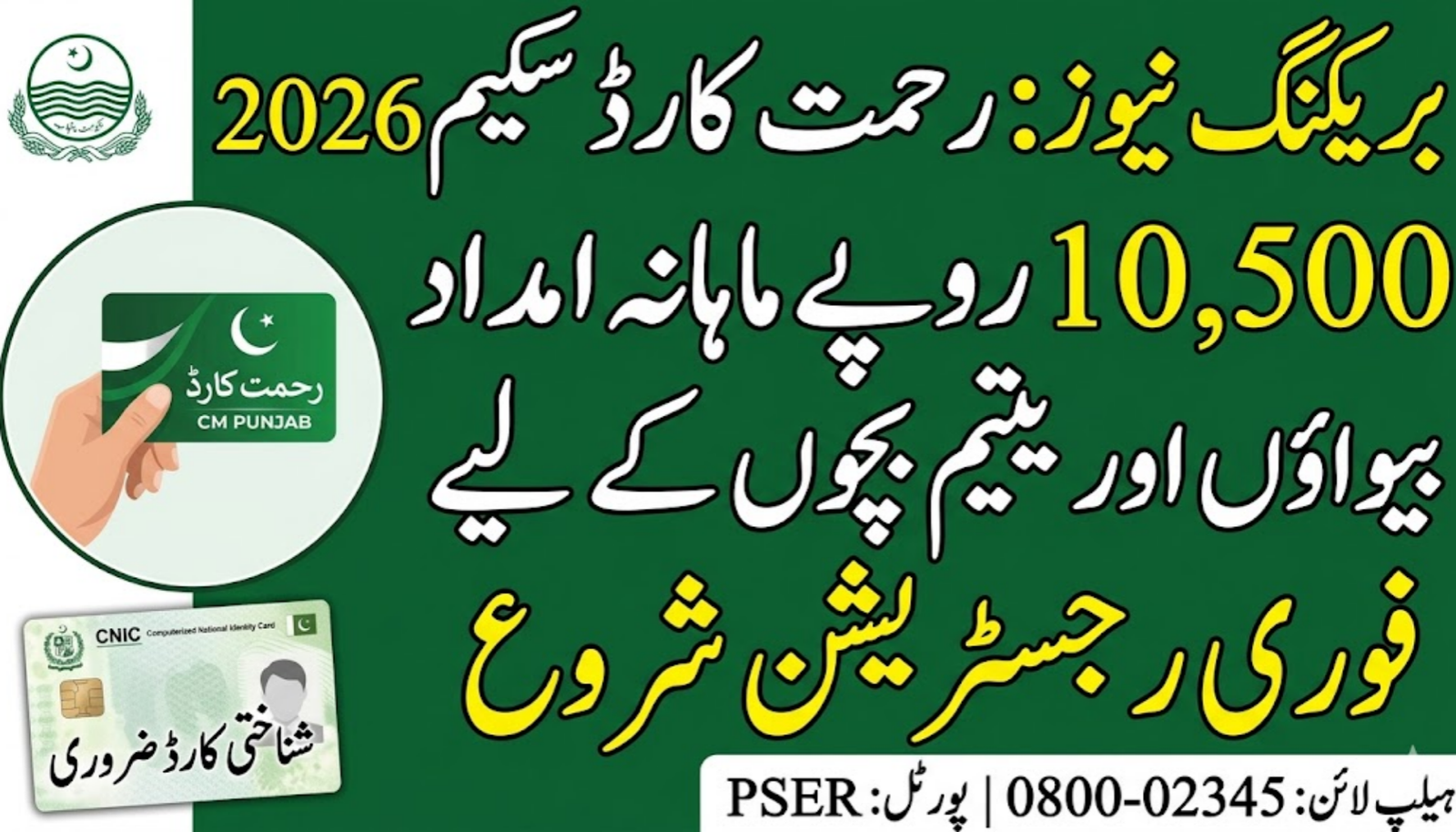
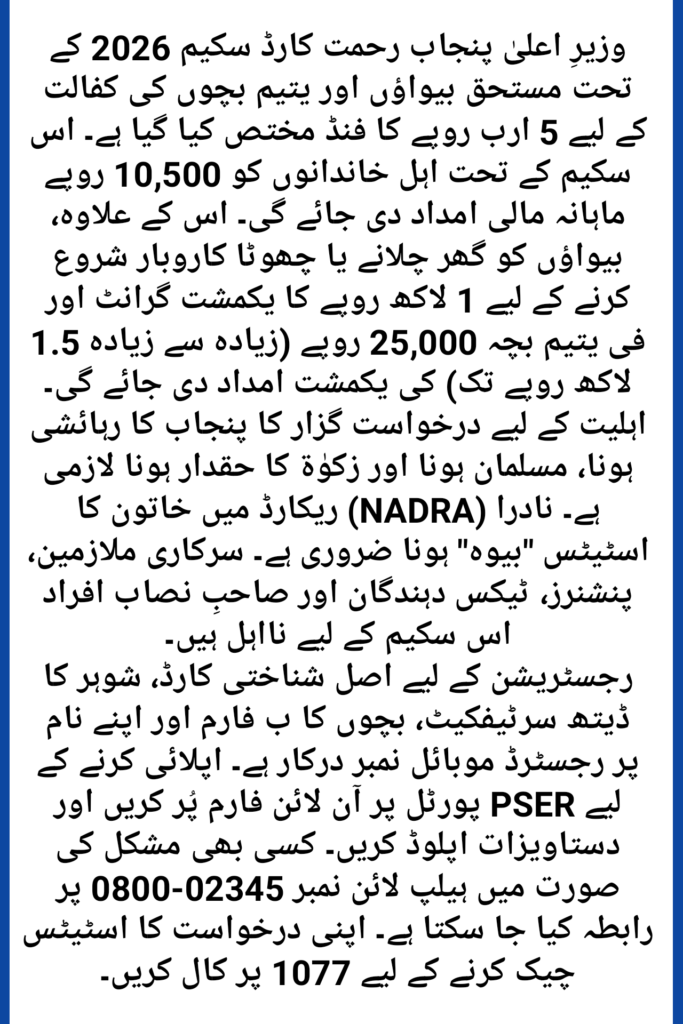
Officially approved by Chief Minister Maryam Nawaz Sharif with a massive initial allocation of Rs. 5 billion from the provincial Zakat Fund, the program is designed not as a hand-out or standard charity, but as direct state patronage (Sarkari Kafalat).
If you are a widow, an independent guardian of orphaned children, or a low-income household trying to find out if you qualify, this guide details the exact rahmat card eligibility criteria and monthly benefits 2026 so you can secure this vital financial lifeline.
Table of Contents
Rahmat Card Eligibility Criteria: Do You Qualify?
To ensure the Zakat-backed funds reach those who truly need them, the government has established strict, non-negotiable compliance parameters. Only Shariah-eligible Muslim widows and orphaned children who legally qualify for Zakat will be integrated into the program.
Core Demographic Requirements
To pass the initial system audit, applicants must firmly fit into one of the following priority categories:
- Widowhood Status: Women who are permanent residents of Punjab whose marital status is formally updated as “Widow” within the National Database and Registration Authority (NADRA) database.
- Orphan Status: Children under the age of 18 who have lost their father or both parents, or guardians legally caring for such minors.
- Poverty Score Threshold: Households must be registered within the Punjab Socio-Economic Registry (PSER) or Benazir Income Support Programme (BISP) database, maintaining a low Poverty Means Test (PMT) score.
Who is Excluded from the Scheme?
The system automatically screens out specific demographics during the verification process. You are immediately disqualified if you fall under any of these banners:
- Government Service: Current or retired employees of federal, provincial, or municipal bodies.
- Pensioners: Individuals already receiving fixed regular monthly retirement payouts from the state.
- Tax Filers: Anyone listed as an active taxpayer with declared taxable income on the Federal Board of Revenue (FBR) portal.
- Sahib-e-Nisab: Wealthy individuals who hold financial assets beyond the Zakat exemption limits.
- Overseas Residents: The applicant must be physically residing within Punjab.
Breaking Down the Financial Structure: Capital Grants and Monthly Benefits
The financial framework of the Rahmat Card is split into two distinct paths: immediate capital injection and recurring monthly relief. This dual-action design provides short-term survival funds while helping families achieve long-term self-reliance.
The Immediate Capital Support
Upon successful selection and profile activation, the program deploys substantial one-time grants to stabilize the household budget:
- Base Widow Grant: A one-time financial allocation of Rs. 100,000 provided to the widow to clear debts, address emergency needs, or invest in home-based micro-enterprises.
- Orphan Child Support: A targeted allocation of Rs. 25,000 per orphaned child to safeguard their immediate welfare.
- Maximum Cap: For larger families with multiple dependent minors, the total initial disbursement can scale up to a maximum of Rs. 150,000.
The Recurring Monthly Relief Scale
Beyond the initial capital lump sum, the program shifts into a predictable, monthly cash transfer pattern to cushion against high inflation.
| Benefit Category | Cash Distribution Scale (2026) | Primary Intended Purpose |
| Recurring Monthly Assistance | Rs. 10500 per month | Essential food items, utility bill support, and daily living costs |
| One-Time Widow Base Grant | Rs. 100000 | Small business setup, livestock purchasing, or vocational capital |
| One-Time Orphan Allocation | Rs. 25000 (per child) | Educational materials, school admission uniforms, and child healthcare |
Mandatory Documentation for a Smooth Application
Before attempting to register, you need to verify your physical paperwork. Missing certificates or outdated data can cause your application status to hang in “Pending” indefinitely.
- Valid CNIC: The applicant’s original national identity card. It is absolutely vital that the widow’s marital status is correctly reflected on the card.
- NADRA Death Certificate: A verified official death certificate of the deceased husband or parent.
- Child B-Form: Essential for calculating orphan allowances for minors under 18.
- Proof of Residence: Domicile certificate or a recent utility bill confirming residency within one of Punjab’s 36 districts.
- Registered Mobile Number: The SIM card must be legally registered under the applicant’s own CNIC to link the digital wallet.
Step-by-Step Online Registration via the PSER Portal
The registration process is entirely digitalized. You can complete the application yourself using a mobile phone or a personal computer.
[ PSER Portal Login ] ➔ [ Enter CNIC ] ➔ [ Input Household Matrix ] ➔ [ Upload Scanned Documents ] ➔ [ Submit & Save Tracking ID ]
Navigating the Portal Without System Errors
- Access the Registry: Go directly to the official PSER or designated Punjab web portal. Do not use unsecured third-party links.
- Profile Generation: Create an account using your active CNIC number and mobile phone number.
- Household Entry: Fill out the data matrix honestly. Include the total number of family members and specify the exact number of dependent children under your care.
- Document Verification: Scan and upload clear photos of your updated CNIC, death certificate, and B-form.
- Finalize Application: Review the entry for typos, submit the form, and save your unique tracking ID. Alternatively, if you face connectivity issues, you can call the toll-free helpline at 0800-02345 or visit your local district Zakat office for hands-on assistance.
Frequently Asked Questions
What is the exact monthly benefit of the Rahmat Card in 2026?
The Rahmat Card provides an ongoing monthly recurring assistance payment of Rs. 10,500 to eligible registered families, along with massive initial structural grants.
Can a divorced woman apply for the Rahmat Card scheme?
No, the core mandate of the Rahmat Card is explicitly tailored toward supporting widows and orphaned children facing deep financial distress. Divorced or single women facing financial hardship are directed to apply for alternative provincial structures like the Himmat Card or general BISP models.
Is there any registration or processing fee for the Rahmat Card?
Absolutely not. The entire registration, document validation, and mobile application process is 100% free. Additionally, the Punjab government covers all service charges related to JazzCash digital wallet transfers.
How do I check my Rahmat Card application status?
You can log back into the official PSER web portal using your CNIC to check if your status reads Approved, Pending, or Rejected. Real-time updates and status tracking details are also accessible by dialing the official help channel at 1077.
Moving Forward and Securing Your Aid
The CM Punjab Rahmat Card 2026 offers an incredibly robust safety net for families dealing with the loss of a primary breadwinner. By keeping your NADRA profile updated and registering early through the PSER portal, you can make sure your household secures these vital monthly benefits. If you qualify, don’t wait—gather your documents and apply today to lock in your financial support.
To view the complete digital inauguration speech, policy objectives, and operational details straight from provincial leadership, you can watch this Punjab Rehmat Card Complete Guide. This video provides helpful visual context on how the mobile wallet infrastructure functions directly for rural users.