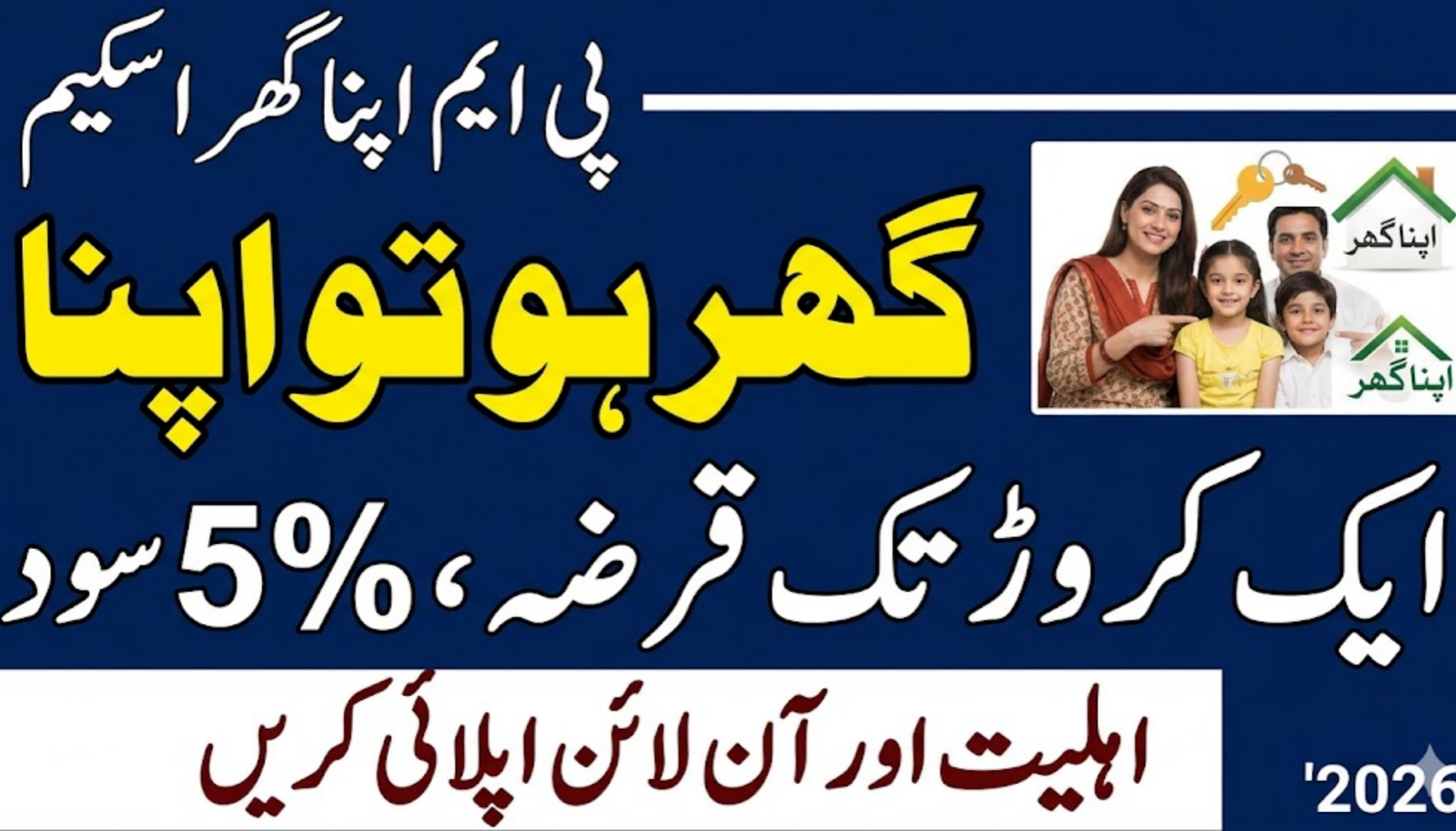
For millions of families renting across Pakistan, the dream of homeownership often gets derailed by skyrocketing real estate prices and high commercial bank interest rates. Recognizing this massive barrier, the federal government’s revamped pm apna ghar scheme 2026 (subtitled Ghar Ho Tu Apna) serves as a heavily subsidized, state-backed initiative designed to help middle and low-income citizens transition from paying endless rent to owning a permanent asset.
Administered in collaboration with the State Bank of Pakistan (SBP) and implemented through designated commercial and Islamic banks, this markup subsidy and risk-sharing framework radically slashes borrowing hurdles.
If you plan to apply this year to build, buy, or secure an apartment, navigating the strict banking criteria is your first vital step. This guide breaks down the updated eligibility matrices, specific income baselines, and exact documentation checklists required to secure rapid file approval.
Table of Contents
Core Operational Parameters of the 2026 Apna Ghar Scheme
The 2026 rollout operates as a specialized Shariah-compliant and conventional hybrid housing finance window. The government absorbs the volatile market interest rates (KIBOR), allowing the end-user to plan their household budgets around a predictable, low-interest payment structure.
Financing Caps, Property Sizes, and Subsidized Rates
To ensure the funds explicitly support working-class families rather than real estate investors, the scheme maintains clear physical and financial boundaries:
- Maximum Financing Limit: Eligible applicants can secure up to PKR 10 million (1 Crore) or 90% of the total property value, whichever is lower.
- Property Structural Limits: Covered areas are strictly capped. For standalone houses, the limit is up to 10 Marla (or 2,720 sq. ft.). For flats and residential apartments, the limit is capped at 1,500 sq. ft.
- The 10-Year Fixed Profit Cushion: For the first 10 years of your financing tenure, the borrowing rate is locked at a flat 5%. After this introductory decade, the pricing transitions to the standard market benchmark (typically 1-Year KIBOR plus a fixed bank spread of 3%).
- Financing Tenor: Borrowers can distribute their repayment journey across a flexible timeline spanning from 5 to 20 years.

Comprehensive PM Apna Ghar Scheme 2026 Eligibility Criteria
Securing an allocation under this credit-sharing mechanism requires satisfying strict baseline parameters. Banks are legally bound by SBP regulations to thoroughly audit your current housing status and demographic background.
Fundamental Demographic and Property Ownership Rules
To qualify for the subsidy, an applicant must satisfy three unalterable structural requirements:
- The First-Time Homeowner Mandate: The primary applicant must be a first-time homeowner in Pakistan. You cannot own any alternative residential plot, house, or apartment registered under your name at the time of file processing.
- Citizenship & Identity Verification: You must be a legal citizen of Pakistan holding a valid Computerized National Identity Card (CNIC). Non-Resident Pakistanis (NRPs) are also eligible provided they hold a valid National Identity Card for Overseas Pakistanis (NICOP).
- One-Time Facility Cap: This state-backed housing subsidy can only be utilized once in a lifetime by a single individual or family unit.
Age and Minimum Net Monthly Income Baselines
Your financial health dictates which tier of financing your file lands in. Across major retail banks like Meezan Bank, HBL, and Bank Alfalah, the age and income thresholds are uniformly evaluated:
- Age Limits at Maturity: Applicants must be a minimum of 25 years old when submitting the file. The maximum age at the time of final loan maturity must not exceed 60 years for salaried individuals or 65 years for self-employed businessmen.
- Minimum Disposable Income: Your net monthly disposable income must clear a mandatory benchmark. Most corporate banks require a verified net take-home salary or business income of at least PKR 37,000 to PKR 40,000 per month.
- Employment & Business History: Salaried individuals must show a minimum of 6 months of continuous service in their current industry. Self-employed individuals and independent professionals must provide clean evidence of running their current business entity for at least 2 years.
Mandatory Document Checklists: What You Need to Apply
Once you verify your eligibility, your next hurdle is gathering the precise documentation required by the credit risk departments. The scheme uses a color-coded application framework to separate salaried individuals from informal earners.
1.General Documents Required for All Applicants
No matter your employment sector, every single file must contain this baseline identity stack:
- Signed Loan Application Form (LAF) alongside a completed Credit Information Bureau (CIB) undertaking.
- Clear photocopies of valid CNICs or NICOPs for both the primary applicant and any co-applicants.
- Two recent passport-size colored photographs.
- A formal, legally binding written undertaking confirming your status as a first-time homeowner.
- Photocopies of allotment letters, transfer documents, or legal Title Deeds of the property being mortgaged (if identified).
2. Specific Documentation for Salaried Workers (Green Form)
If you earn a formal corporate or government paycheck, you must verify your stability using these items:
- An official Employment Certificate or verified letter from your HR department stating your designation, joining date, and employment status (permanent or contractual).
- Your original current Salary Slip (not older than 60 days) clearly outlining your gross pay, detailed allowances, and monthly deductions.
- An Account Maintenance Certificate alongside your official bank statements covering the last 6 to 12 months showing your regular salary credits.
3. Documentation for Self-Employed & Business Owners (Blue Form)
For registered merchants, freelancers, and independent contractors, the bank measures risk using your corporate footprint:
- Formal Proof of Business stating ownership longevity (e.g., a registered Partnership Deed, a Chamber of Commerce registration, or an NTN Certificate).
- An official Account Maintenance Letter backed by your certified corporate or personal bank statements tracking the latest 12 months of active cash flow.
- Valid professional degrees, diplomas, or active memberships to recognized corporate or professional bodies (for doctors, engineers, or certified accountants).
4. Alternative Proxies for Informal Income Earners (Pink Form)
A major highlight of the Ghar Ho Tu Apna framework is its specialized track for cash-based workers, shopkeepers, and informal laborers who lack traditional pay slips. Banks can assess your repayment capability using practical lifestyle proxies:
- Legitimate, signed rent agreements or historical rent payment declarations.
- Paid utility bills (electricity, gas, or PTCL) spanning the last 6 months to establish average household expenditures.
- Children’s school fee challan copies to cross-verify monthly disposable income limits.
Frequently Asked Questions
Are there any processing fees or hidden charges under the PM Apna Ghar Scheme 2026?
No. To maximize affordability for lower-income applicants, the State Bank of Pakistan has strictly mandated that commercial banks charge zero processing fees and zero prepayment penalties if you choose to pay off your housing loan earlier than the agreed tenor.
Can multiple family members combine their incomes to meet the salary requirements?
Yes. The scheme fully permits co-applicant income clubbing. You can combine incomes with up to four immediate family members (spouse, parents, adult children, or siblings) to comfortably clear the minimum PKR 40,000 threshold and qualify for a higher total financing amount.
Can I use this scheme to purchase an open residential plot?
You cannot use the facility to buy a vacant plot as a standalone investment. However, you can use it for a combined transaction: purchasing a residential plot and financing the immediate construction of a house on it simultaneously.
What happens if the property I choose is worth more than PKR 11 million?
The maximum loan amount provided by the bank will remain capped at PKR 10 million. If the property value exceeds this ceiling, you must cover the remaining balance yourself out of pocket as your custom equity contribution, while still adhering to the property size limits (10 Marla or 1,500 sq. ft.).
Is this housing finance program fully Shariah-compliant?
Yes. Major participating institutions like Meezan Bank, HBL Islamic Banking, and Allied Islamic Banking offer this scheme through the Diminishing Musharakah model. Under this structure, you and the bank enter a joint ownership agreement where you gradually purchase the bank’s share over time until you become the sole owner.
Securing Your Path to Homeownership
The pm apna ghar scheme 2026 bridges the gap between low incomes and high property costs. By capitalizing on a fixed 5% rate for the first decade, you protect your household from volatile macroeconomic shifts. To ensure a smooth approval process, locate your designated local bank branch, complete your income validation paperwork cleanly, and ensure your credit history contains zero active defaults. Taking the time to properly organize your application file today can save you from years of paying rent tomorrow.