bisp-dynamic-survey
Discovering that your household has been marked as ineligible for the Benazir Income Support Programme (BISP) can feel like a sudden financial roadblock. For millions of families relying on programs like the Benazir Kafaalat cash transfers, these monthly or quarterly distributions are not just supplementary welfare—they are the baseline for survival against steep inflation.
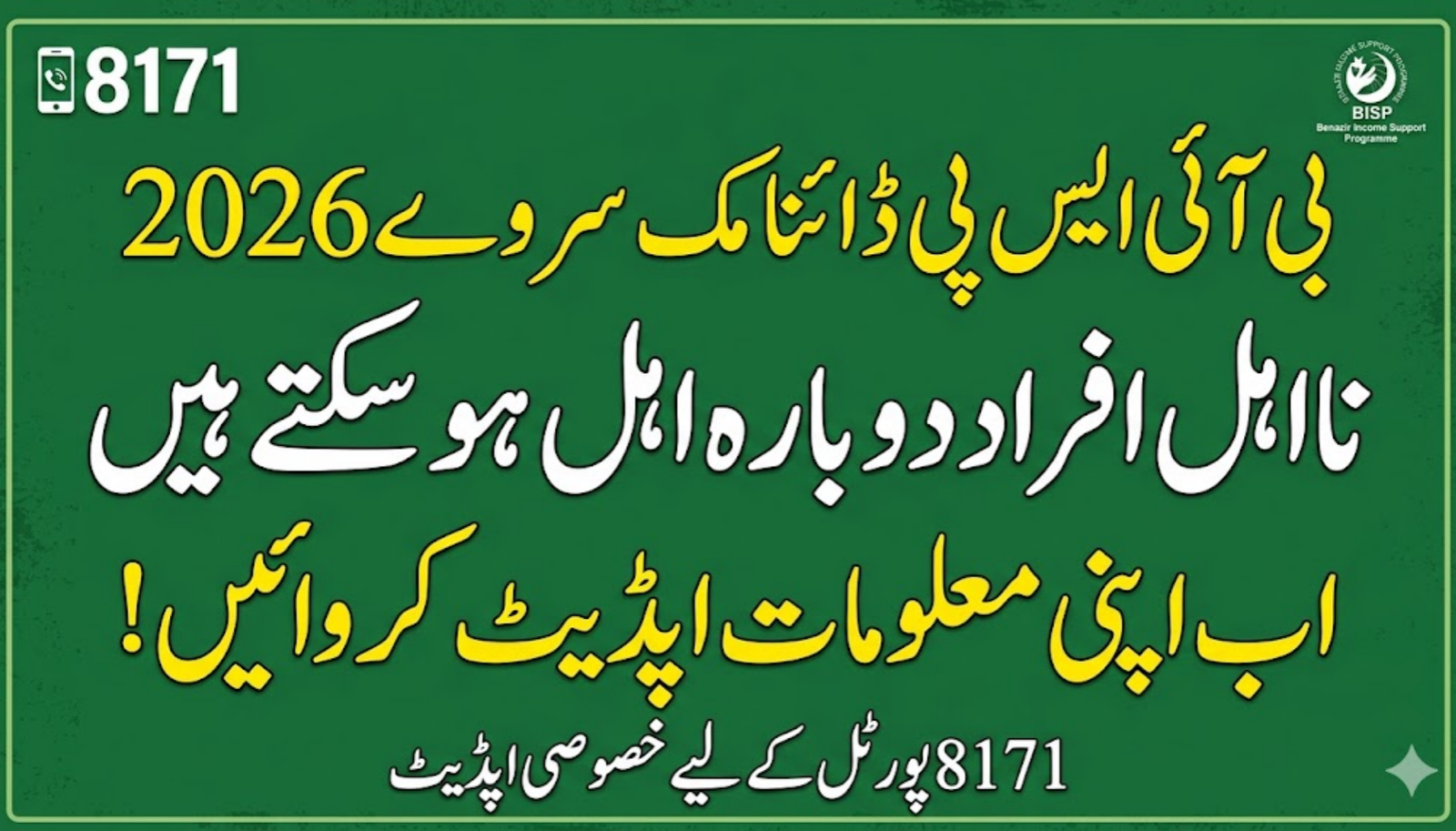
Fortunately, an “ineligible” status on the 8171 web portal is no longer a permanent rejection. Through the newly optimized BISP dynamic survey updates for ineligible families 2026, the Ministry of Poverty Alleviation has established a continuous verification pipeline. This system offers disqualified households a structured second chance to correct outdated data, update their socio-economic profile, and lower their Proxy Means Test (PMT) scores to meet current eligibility thresholds.
If your household payments have stalled or your initial application was turned down, this comprehensive strategist’s guide walks you through the 2026 re-registration process, required document frameworks, and data matching keys.
Table of Contents
Decoding the Mechanism of the 2026 BISP Dynamic Survey
Unlike older, static National Socio-Economic Registry (NSER) iterations that only surveyed the population once every few years, the 2026 dynamic registration registry operates as a live database. It adapts as fast as your real-world household dynamics change.
Why Was the Dynamic Registry System Introduced?
The dynamic survey framework was deployed to eliminate inclusion and exclusion errors within Pakistan’s social safety net. In the past, if a household fell into poverty due to the loss of a primary breadwinner or a sudden medical emergency, they had to wait years for a new national census or survey drive to prove their eligibility.
The current system acts as an open government database. It allows any citizen to walk into a designated tehsil office to register life updates, ensuring that state welfare distribution matches immediate, real-time ground realities.
The Metrics Governing Your Household PMT Score
BISP assesses your financial vulnerability through an algorithmic score known as the Proxy Means Test (PMT). The system aggregates multiple data points rather than looking solely at a basic salary slip. Key indicators evaluated during the survey include:
- Household Dependents: The ratio of school-going children, elderly relatives, and disabled family members to working adults.
- Asset Ownership & Infrastructure: Structural characteristics of your home (such as concrete roofing vs. mud walls) and land ownership records.
- Utility Footprints: Monthly electricity and gas consumption patterns pulled directly from corporate distribution databases.
- Cross-Border Travel History: Passport data matches via NADRA to check if any family member has traveled or worked abroad.
Primary Reasons Families Are Declared Ineligible in 2026
Before launching an appeal or requesting a survey rewrite, you must diagnose why the 8171 portal flagged your household as non-eligible. Most disqualifications stem from automated data mismatches
│ COMMON DISQUALIFICATION TRIGGERS │
Outdated NSER Data PMT Score Spike NADRA Registry Flaws
– Old family sizes – High utility bills – Expired CNICs
– Outdated income info – Asset registration – Unlinked B-Forms
Household Information Became Outdated Over Time
A common reason for sudden exclusion is unrecorded household transitions. If your NSER profile was filled out years ago when a household member held a temporary job, the system assumes that income stream is still active. Failing to notify BISP of a job loss, a business closure, or the passing of a primary earner leaves your profile artificially wealthy in the eyes of the algorithm.
Sudden Spikes in the Proxy Means Test (PMT) Threshold
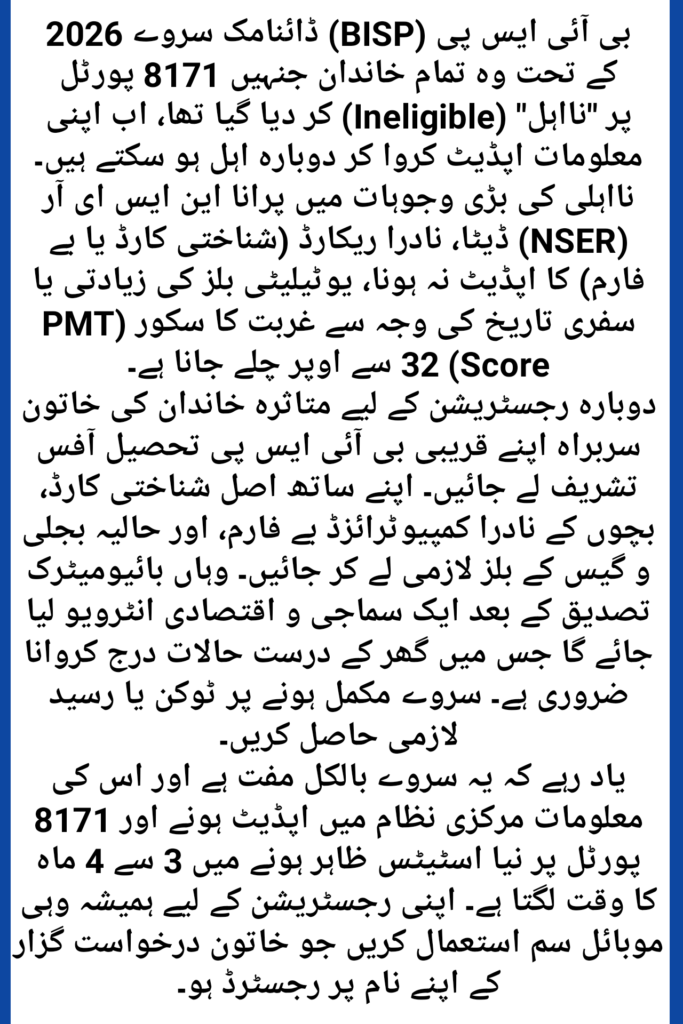
The cut-off PMT score for programs like the Benazir Kafaalat phase is strictly maintained around a value of 32 for general eligibility. If your utility bills spiked drastically over a hot summer, or if a vehicle or plot of land was registered in your name even temporarily for a family business transition—your automated PMT value will cross the qualifying limit, triggering an immediate payment freeze.
NADRA Data Verification and Registry Bottlenecks
BISP works in lockstep with the National Database and Registration Authority (NADRA). If a female head of household has an expired CNIC, or if newborn children are not officially added via NADRA B-Forms, the BISP verification engine flags the household as an unverified unit. Similarly, marital status changes must be officially updated; otherwise, the system cannot process targeted women-led household benefits.
How the BISP Dynamic Survey Benefits Ineligible Households
The 2026 updates turn what used to be a rigid bureaucratic system into an actionable path to recovery for genuinely deserving families.
An Opportunity to Correct Data Discrepancies
The primary benefit of the dynamic survey is the ability to clear up false system assumptions. If the FBR or land registry systems have mistakenly linked an asset to your CNIC, or if your name and household composition are riddled with typographical errors, the interview allows you to present paper evidence to rectify the database.
What Should I Do If My Payment Is Not Showing on 8171?
If the 8171 web portal or SMS service responds with “Not Eligible at This Time” or if your scheduled Rs. 14,500 installment fails to show up, it indicates a structural data audit is required. Rather than repeatedly sending SMS text messages, your next move must be a physical visit to a registration center. The dynamic survey is your formal tool to override previous rejections.
Re-Registration Process for BISP Disqualified Families
Re-entering the BISP safety net requires a systematic approach. Follow this step-by-step procedure to ensure your survey is logged cleanly into the system.
1.Verify Status and Visit a BISP Tehsil Office:Prerequisite Step.
Check your status on the 8171 portal. If marked ineligible, locate your closest designated BISP Tehsil Registration Center. Surveys cannot be done via online web apps or mobile tools; you must present yourself in person.
2.Present Legal Identity Documents:Document Audit Phase.
Approach the data entry counter and provide the desk officer with your original, valid CNIC. For households tracking child education stipends (Taleemi Wazaif), you must hand over the official NADRA B-Forms for all children.
3.Execute Biometric Fingerprint Verification:Security Phase.
The counter operator will run your thumbprint through the live biometric scanner linked directly to NADRA. This step confirms your active identity and ensures no duplicate profiles exist across different districts.
4.Complete the Socio-Economic Interview:Data Entry Phase.
Answer the desk officer’s questions accurately. You will be asked about your actual household size, monthly gas/electricity bills, school enrollment, income status, and physical property conditions. Ensure all answers match your physical paperwork.
5.Collect the Formal Survey Receipt:Confirmation Phase.
Once the operator submits the form, demand your printed digital token or survey receipt. This document contains your tracking number, proving your case has been successfully queued for a updated PMT score evaluation.
Expert Strategic Tip: Always register a mobile SIM card that is explicitly issued in the name of the female applicant. BISP sends critical verification codes, cash distribution updates, and survey confirmations solely to the mobile number tethered to the applicant’s CNIC in the official telecommunication registry.
Essential Documents Matrix for a Successful Re-Survey
Going to a tehsil center without the proper paperwork means a wasted trip. Put together a dedicated folder containing these verified records before you leave home:
- Identity Keys: Original CNICs of the applicant and spouse (cards must not be broken or expired).
- Family Registry Evidence: Computerized NADRA B-Forms for every child living under your roof.
- Vulnerability Proofs (If Applicable): Official death certificate of the husband if applying under the widow quota, or a disability-certified CNIC issued by NADRA.
- Economic Baseline Paperwork: Recent monthly electricity and gas bills to verify your household utility footprint.
Frequently Asked Questions
Can an ineligible family apply again through the dynamic survey?
Yes. Any family previously marked as ineligible can initiate a re-survey if their last structural NSER evaluation occurred more than three years ago, or if they have experienced a significant shift in household income, marital status, or family size.
Is the BISP Dynamic Survey free of cost?
Yes, the entire dynamic survey process—including registration, verification, and interviews at government centers—is completely free. No official or agent is authorized to charge fees for entering your data or adjusting your profile.
How long does it take for eligibility to update after the survey?
Once your data is uploaded via the tehsil office, it takes less than three to four months for the central verification engine to re-calculate your PMT score and update your final status on the 8171 web portal.
What is the maximum PMT score allowed for the Benazir Kafaalat program?
The standard PMT score threshold for active cash assistance programs is generally set at a maximum score of 32. If your re-survey pulls your calculated poverty index below this score, your status will change to eligible.
Restoring Your Financial Safety Net
The BISP dynamic survey updates for ineligible families 2026 provide an essential course correction for households wrongly locked out of state welfare. Do not let a stale, outdated NSER profile prevent your family from getting the financial relief they qualify for. Gather your updated NADRA documents, visit your nearest tehsil center, and ensure your household profile accurately reflects your real-world economic situation.