8171 Online Check 2026
Waiting for critical financial assistance shouldn’t feel like a guessing game. For millions of families across Pakistan, verifying the release of their quarterly stipend is the difference between meeting essential household needs and falling behind.
The Government of Pakistan, under the leadership of BISP Chairperson Rubina Khalid, has officially structured the new disbursement cycle, increasing the core quarterly stipend to a permanent base of Rs. 14,500 per eligible household to offset persistent inflation. If you are tracking your family’s funds, knowing exactly how to use the 8171 check online CNIC 2026 platform is the fastest way to confirm your cash is ready for pickup without leaving your home.
Understanding the 8171 Web Portal Framework for 2026
The structural backbone of Pakistan’s social safety net programs relies heavily on central verification architectures. Rather than traveling miles to a regional office just to ask if your funds have arrived, the state provides a direct-access point. The 8171 tracking portal functions as a direct live window into the National Socio-Economic Registry (NSER) database, which contains the economic profiles of over 35 million households.
When the state distributes funds, it does so in cascading administrative tranches rather than an all-at-once drop. This phased distribution prevents localized network crashes and manages the massive physical liquidity required at localized commercial retail locations. Therefore, seeing a “pending” status simply means your localized region or specific demographic tier hasn’t been targeted in the current week’s release schedule.
Core Program Components Tracking via 8171
The utility of the 8171 framework stretches beyond a single program. The dashboard functions as a unified tracking center for multiple parallel social protection tracks:
- Benazir Kafaalat Program: The foundational quarterly unconditional cash transfer program targeting women heads of households, currently paying out the updated Rs. 14,500 baseline allocation.
- Benazir Taleemi Wazaif: Conditional cash transfers for education, providing supplemental quarterly stipends ranging from Rs. 2,000 for primary school students up to Rs. 4,000 for higher secondary levels, assuming a strict 70% school attendance record.
- Benazir Nashonuma: A health-and-nutrition-linked conditional cash transfer program offering specialized support up to Rs. 3,000 for pregnant women and infants to combat stunting.
How to Perform an 8171 Check Online by CNIC in 2026
Checking your payment status online requires zero technical expertise, but it demands strict precision with your documentation entries. A single typo in your identity document number can lead to an erroneous “record not found” error screen.
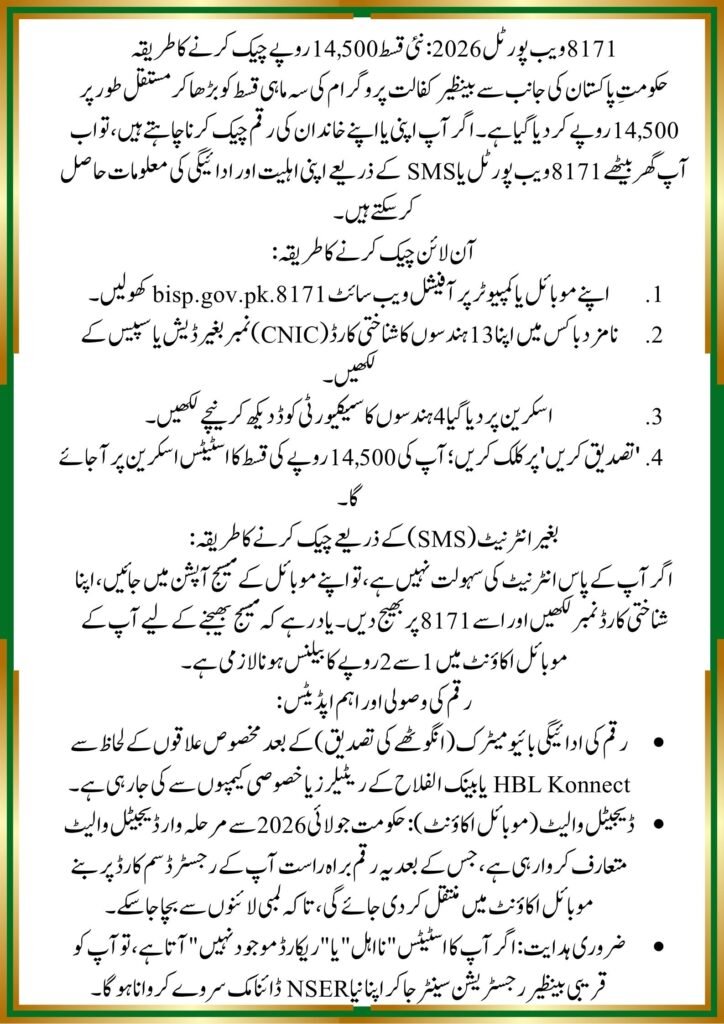
1.Access the Verified Portal:Requires internet connection.
Open the internet browser on your smartphone or computer and navigate directly to the official URL: 8171.bisp.gov.pk. Avoid searching for this on untrusted third-party search engines to protect your personal identity information.
2.Input Your National Identity Information:13-Digit CNIC Format.
Locate the designated input box labeled for your Computerized National Identity Card number. Type your 13-digit CNIC carefully without inserting any hyphens, dashes, or blank spaces.
3.Complete the Security Captcha Validation:Anti-Bot Security Screen.
Look closely at the 4-digit numeric code displayed within the system-generated image on the screen. Re-type those exact numbers into the verification box directly beneath the image to confirm you are a human user.
4.Submit and Interpret the System Result:Instant Live Feedback.
Click the green submission button. Within seconds, the database will pull your file and display your live eligibility status, showing whether your Rs. 14,500 payment has been cleared, is pending, or if your household requires an updated NSER dynamic survey.
Alternative Verification Method via 8171 SMS Service
Internet access remains a significant barrier for rural beneficiaries located outside primary urban telecom grids. To bridge this digital divide, the Ministry of Poverty Alleviation maintains a dedicated short-code SMS processing architecture that runs entirely on standard GSM infrastructure without needing mobile data.
How to Check 8171 Status Without Internet Access
- Open the native text messaging or SMS application on any standard mobile phone.
- Draft a completely new message and type your 13-digit CNIC number linearly without spaces or special characters.
- Address the message to the official short-code: 8171.
- Press send.
Important Carrier Fee Note: Sending an SMS to 8171 requires a nominal carrier network fee of roughly Rs. 1 to 2 plus tax. Ensure your SIM card balance has basic mobile credit before attempting the query, as the request will fail instantly on a completely dry account balance.
Within a few minutes of sending your text, you will receive an automated reply from the central server detailing your registration standing and confirming whether your current quarterly stipend is clear for biometric withdrawal.
Decoding Your 8171 Web Portal Query Results
The online portal spits out definitive status signals based on what it sees in the database. Understanding these terms tells you exactly what step to take next.
What Does an ‘Eligible’ (Ahal) Status Mean?
If your screen flashes a green confirmation showing you are eligible for the current cycle, your profile has met the necessary Poverty Score card metrics (PMT score parameters). The system will clearly print out if your Rs. 14,500 payment has been dispatched to your regional banking partner. You can proceed directly to an authorized cash point.
Dealing with ‘Ineligible’ (Na-Ahal) Assessment Responses
An ineligible status indicates that your registered household metrics place you above the current target poverty thresholds set by the federal planning boards. This could be due to asset ownership records, international travel history tied to your CNIC, or changes in household income patterns. If your economic situation has worsened since your last check, you will need to apply for a fresh screening via a dynamic survey at a local administrative hub.
The Meaning of ‘No Record Found’ Notifications
Seeing this means your identity card has never been formally registered within the NSER database architecture. It can also occur if your old computerized identity card has expired and you haven’t updated your records with the authority. Your priority here should be getting an active survey on file.
offichal website ; https://8171.bisp.gov.pk/
Payment Collection Points and the New 2026 Digital Wallets
Securing a positive confirmation on your mobile display is only half the battle; collecting your funds safely requires knowing where to go and what security protocols to expect.
Biometric Retailers and Partner Bank ATMs
The state distributes funds through localized banking commercial networks to ensure secure handoffs. Depending on your specific district geography, your funds will be routed through:
- HBL Konnect: Accessible via authorized local retail shopkeepers and specialized biometric agents across Punjab, Sindh, and Balochistan.
- Bank Alfalah: Serving northern and western jurisdictions including Khyber Pakhtunkhwa, Gilgit-Baltistan, and Azad Jammu and Kashmir.
When visiting an agent or an ATM, you must present your original physical CNIC. No photocopies, digital phone pictures, or tokens from NADRA are legally accepted. The agent will require a live biometric thumb impression scan on their point-of-sale device to unlock and release the funds.
The July 2026 Social Protection Digital Wallet Rollout
To eliminate long lines at campsites and stop fraudulent agents from charging illegal fees, the government is shifting toward a direct-to-consumer mobile model. Starting in July 2026, a phased rollout of the Social Protection Digital Wallet framework begins.
Under this updated mechanism, funds are pushed directly into a secure digital wallet account tied directly to your biometric-verified mobile SIM. When your wallet is credited, you will get a direct confirmation text from 8171. You can then withdraw your cash smoothly at any standard bank ATM or transfer it electronically to pay utility bills.
Frequently Asked Questions (FAQs)
What should I do if the 8171 web portal fails to load?
The portal handles millions of parallel pings when a fresh payment cycle goes live, which can cause local server timeouts. If the page doesn’t load, clear your browser cache, avoid using heavy VPN networks, and try accessing the site during off-peak hours like early morning or late evening.
Is there a registration fee for checking my status online or at an office?
No. The 8171 online tracking tool and all physical registration services at official government offices are completely free of charge. If an agent or individual asks for a fee or a cut of your money to verify your status, report them immediately to the official helpline.
Why does the system show my payment is released but the agent says there is no cash?
This usually indicates an individual agent is facing liquidity shortages at their specific retail shop, or they are hovering for an unauthorized fee. If an agent denies your payout despite an “eligible” portal confirmation, try visiting an official commercial bank ATM or an organized central district campsite instead.
Can I check my family members’ payment status using my own mobile phone?
Yes. The online platform does not track the device making the request. You can check multiple identity cards for your relatives or neighbors on a single smartphone, provided you enter each individual’s correct 13-digit identity number and pass the security captcha screen for each search.
How often do I need to update my household NSER dynamic survey?
The state recommends updating your household survey details every three years, or whenever a major life event occurs such as a change in marital status, the birth of a child, or the passing of a household provider. Keeping this updated ensures your PMT score reflects your true, current economic situation.